How to validate your startup idea: a proven step-by-step process

TL;DR:
- Most startups fail due to lack of product-market fit, not technology or team issues.
- Deep customer discovery and structured validation are essential for early-stage investor readiness.
- Continuous, small validation wins build credibility and prevent costly failures or pivots.
Nearly half of all VC-backed startups collapse not because of bad technology or poor execution, but because they built something nobody wanted. Skipping or rushing validation is one of the costliest mistakes a pre-seed founder can make, and the data backs that up. This article walks you through a structured, repeatable validation process built specifically for early-stage tech founders. You’ll learn how to prepare through deep customer discovery, run lean experiments, measure the signals that actually matter to investors, and troubleshoot weak results before they become fatal. If you’re serious about reaching investor readiness, this process is your roadmap.
Table of Contents
- Why most startups fail without validation
- Set the foundation: Pre-validation and deep customer discovery
- The lean validation cycle: Build-Measure-Learn in action
- Measuring what matters: Picking metrics and verifying traction
- From learning to investor readiness: Troubleshooting and next steps
- Our perspective: Rethinking validation—why micro-wins beat the perfect plan
- Accelerate your validation with Freshmango’s support
- Frequently asked questions
Key Takeaways
| Point | Details |
|---|---|
| Validate before building | Customer discovery and evidence-based testing slash your odds of building something nobody wants. |
| MVP means learning | Your minimum viable product exists to test actions and assumptions—not to impress with polish. |
| Investors value proof | Traction signals like waitlists and pilots matter more than revenue in pre-seed fundraising. |
| Iterate, don’t hesitate | Quick, honest feedback and regular pivots beat stubbornness and wasted capital every time. |
| Structure accelerates results | A repeatable, milestone-driven process increases your chances of raising and scaling. |
Why most startups fail without validation
Following our overview of what is at stake, let’s explore why so many promising tech startups still fall at this first hurdle.
The number is hard to ignore: 43% of VC-backed startups fail because of poor product-market fit or no real market need. That’s not a funding problem or a team problem. It’s a validation problem. Founders convince themselves they’re solving a real pain point, but they’ve never stress-tested that assumption with the people who would actually pay for it.
Running out of capital is another commonly cited cause, but it’s usually a symptom, not the root issue. When your product doesn’t resonate, you burn cash trying to force traction that never comes. The money runs out because the market signal was never there to begin with.
One of the most persistent misconceptions is that having a technically impressive product is the same as solving a real problem. It isn’t. Founders at the pre-seed stage often skip qualitative milestones like customer interviews and early prototypes because they feel less “real” than revenue. But those early signals are precisely what separates fundable startups from expensive lessons.
The Techline market need challenge is a clear example of how even well-resourced teams can misjudge demand without structured validation. The pattern repeats across sectors and geographies.
The top failure causes from CB Insights 2026 paint a consistent picture:
- No market need (43%)
- Ran out of cash (38%)
- Wrong team (23%)
- Got outcompeted (19%)
- Pricing or cost issues (18%)
“The best founders we see obsess over the problem, not the product. They can describe their customer’s pain in vivid detail before they’ve written a single line of code.” — Pre-seed investor note on early-stage evaluation criteria
That shift in focus, from product to problem, is the foundation of every successful validation process.
Set the foundation: Pre-validation and deep customer discovery
Understanding the most common failure points, let’s begin with the groundwork all investors expect: talking to your future customers.
Deep customer discovery is not a one-hour survey. It’s a structured process of interviews, direct observation, and sometimes shadowing real users in their environment to understand the friction they experience daily. You’re not pitching. You’re listening. The goal is to surface pains so acute that people are already cobbling together workarounds.

Investor readiness at the pre-seed stage doesn’t require revenue. It requires a milestone plan that demonstrably retires risk. Investors want to see that you’ve spoken to real humans, identified a repeating pattern of pain, and have a clear thesis about why your approach addresses it better than what exists today. Tracking qualitative milestones like interview themes and prototype reactions is how you build that evidence base.
YC emphasizes deep problem understanding through customer conversations before applying, treating it as a baseline expectation rather than a bonus.
Here is a five-step customer discovery checklist to work through before you build anything:
- Define your assumed customer segment as specifically as possible (role, industry, company size, behavior).
- Recruit 8 to 12 people who match that profile and have no personal connection to you.
- Conduct 30 to 45 minute open-ended interviews focused entirely on their current problems, not your solution.
- Document recurring themes, exact language used, and emotional intensity around specific pain points.
- Synthesize findings into a one-page problem brief that guides your next build decision.
Following pre-seed risk mitigation steps like these gives you a defensible story when investors ask what you know and how you know it.
Pro Tip: Never ask interviewees if they would use or pay for your product. That question produces false positives. Instead, ask them to walk you through how they currently handle the problem. Behavior reveals truth; hypotheticals mislead.
Applying best practices for customer engagement from the start protects you from building in the wrong direction.
“Founders who can articulate their customer’s problem better than the customer themselves have done the work. That’s the bar.” — YC-aligned perspective on pre-seed validation
The lean validation cycle: Build-Measure-Learn in action
With a clear picture of your customers’ pain points, it’s time to turn learning into structured experimentation.
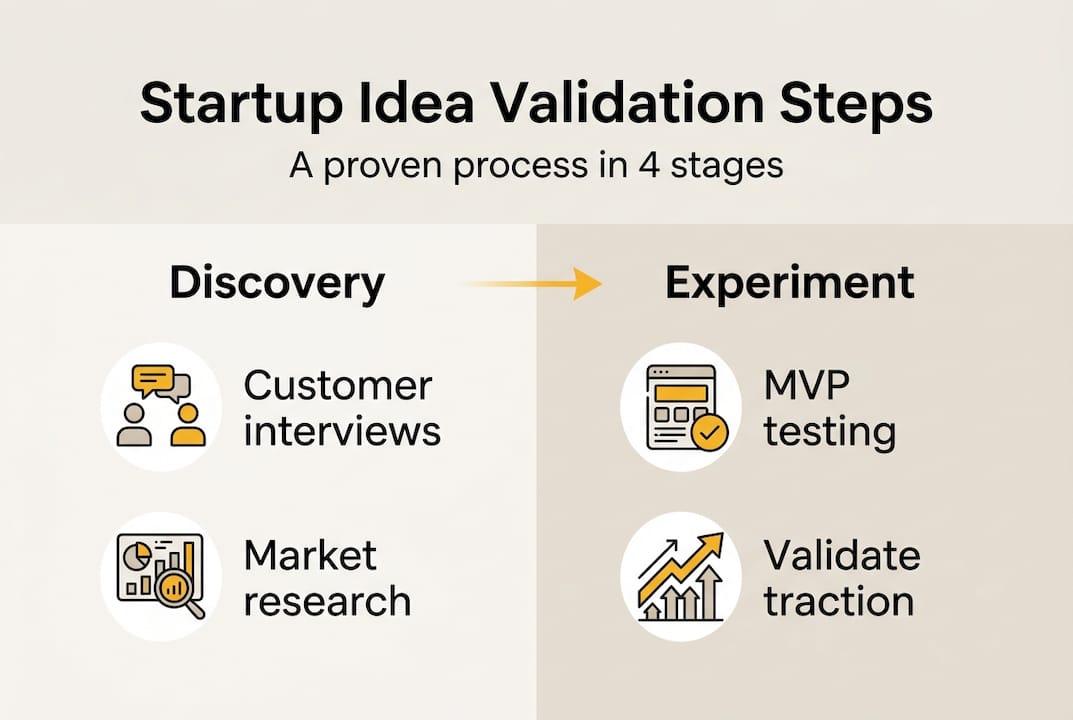
The Build-Measure-Learn loop, introduced through the Lean Startup methodology, is the most practical framework for pre-seed founders who need to move fast without wasting resources. The core idea is simple: build the smallest possible thing that tests your most critical assumption, measure real user behavior, and use what you learn to decide what to build next.
For pre-seed startups, an MVP is not a polished product. It’s the minimum artifact needed to generate a real signal. That could be a landing page, a manual concierge service, or a clickable prototype. The choice depends on what assumption you’re testing.
| MVP type | Best for testing | Time to build | Cost |
|---|---|---|---|
| Landing page | Demand and messaging | 1 to 3 days | Very low |
| Concierge model | Willingness to pay, workflow fit | 1 to 2 weeks | Low |
| Clickable prototype | UX flow, feature priority | 1 to 3 weeks | Low to medium |
The Build-Measure-Learn loop instructs founders to measure concrete outputs like click-through rates, sign-ups, and conversion rates rather than assumptions about future behavior.
Running the loop effectively comes down to three steps:
- Identify the single riskiest assumption in your business model and design the simplest test that could disprove it.
- Set a measurable success threshold before you launch (e.g., 15% email sign-up rate on a landing page).
- Run the test for a defined period, collect data, and make a documented decision to iterate, pivot, or proceed.
Top accelerators look for early signals like waitlists, pilot sign-ups, and organic referrals because they indicate pull, not push. Exploring MVP validation methods used by accelerator-backed founders can sharpen your approach significantly.
When choosing your infrastructure, reviewing a cloud MVP platforms comparison helps you avoid over-engineering your technical stack at this stage.
Pro Tip: Scope your MVP around one core action you want users to take. If your test requires users to do three things to generate a signal, you won’t know which step caused the result. Isolate variables.
Measuring what matters: Picking metrics and verifying traction
You’ve built and tested your MVP. Now it’s vital to capture and frame your progress in a way investors can trust.
Not all metrics are created equal. At the pre-seed stage, the metrics that matter are the ones tied to real user behavior: conversion rates, engagement depth, referral rates, and pilot agreements. These signals tell a story about whether people actually want what you’re building.
Traction signals like waitlists and pilots are key indicators of pre-seed readiness, and investors increasingly expect to see them before writing a check.
| Traction signal | What it means | Investor milestone |
|---|---|---|
| Email sign-up rate | Messaging resonance and demand | 10%+ on targeted traffic |
| Pilot agreement | Willingness to commit time or money | 2 to 5 signed pilots |
| Referral rate | Organic product-market fit signal | 20%+ of users refer others |
| Session depth | Engagement and retention proxy | 3+ key actions per session |
Understanding what investor expectations look like in practice helps you frame your traction story accurately.
Vanity metrics are the ones that look good in a slide but don’t predict growth. Avoid leading with these:
- Total app downloads without activation data
- Social media follower counts
- Page views without conversion context
- Press mentions without user behavior impact
For ongoing tracking, a simple dashboard using a free tool like Notion or Airtable works fine at this stage. Track your key metric weekly, log what changed, and document your interpretation. When you walk into an investor conversation, you want to show a trend, not just a snapshot. The narrative of learning over time is what builds credibility.
From learning to investor readiness: Troubleshooting and next steps
As you close out a validation cycle, the key skill is using imperfect data to make confident next moves.
Disappointing signals are not failures. They’re data. If your landing page conversion rate is 2% instead of 15%, that tells you something specific: either your audience targeting was off, your messaging didn’t land, or the problem isn’t painful enough to drive action. Each of those has a different fix.
“False positive” feedback is a real risk. Friends, family, and polite strangers will often say they love your idea without ever intending to use it. If your qualitative feedback is warm but your quantitative signals are cold, trust the numbers.
Three checkpoints to decide whether to pivot or persevere:
- After two full validation cycles, if conversion remains below your pre-set threshold, revisit your customer segment definition.
- If users engage but don’t convert, the problem is likely pricing or messaging, not product direction.
- If users convert but don’t return, retention is the issue and your core value proposition needs sharpening.
70% of startups run out of capital as a direct consequence of chasing the wrong market fit for too long. Recognizing the signal early is what separates founders who adapt from those who burn out.
Pro Tip: When you pivot, document the reasoning clearly. Investors don’t penalize pivots. They penalize founders who can’t explain what they learned and why it changed their direction. A well-framed pivot is a credibility builder.
When approaching accelerators or angels, bring a concise risk grid: your top three assumptions, what you tested, what the results showed, and what you changed. Reviewing success stories portfolio from funded founders gives you a realistic benchmark for what that evidence base should look like.
Our perspective: Rethinking validation—why micro-wins beat the perfect plan
Before we wrap up, it’s essential to challenge the old advice around validation with what we’ve seen truly work for pre-seed technology founders.
Validation is not a binary event. It’s not something you pass or fail once before moving on. The founders who build durable companies treat it as a continuous, progressive process where each small external win, a signed pilot, a referral, a candid interview, adds to a compounding evidence base.
The dangerous myth is that you need a perfect plan before you can start gathering proof. That thinking slows you down at exactly the moment when speed matters most. Investors notice learning trajectories, not polished decks. A founder who can say “we tested this, it didn’t work, here’s what we changed and why” is far more fundable than one presenting a flawless strategy with no real-world contact.
“The startups that impress us most aren’t the ones with the best slides. They’re the ones who’ve been wrong three times and learned something specific each time.” — Freshmango mentor insight
This is why we believe in an equity-free founding philosophy that keeps your cap table clean while you’re still in the learning phase. Giving up equity before you have real traction is a costly bet on a plan that hasn’t been tested yet.
Pro Tip: Celebrate the first external user who wasn’t recruited by you. That single data point, someone who found you and acted, is the best conversation-starter in any investor meeting.
Accelerate your validation with Freshmango’s support
Ready to put this process into practice with real accountability and expert guidance?
Structure and accountability are the two things most solo founders lack when working through validation. It’s easy to rationalize weak signals or delay hard decisions when there’s no external pressure to move. That’s exactly the gap Freshmango is built to close.
Our 16-week accelerator gives early-stage founders a structured validation track, mentor-guided feedback loops, and direct access to a curated investor network, all without taking equity. You get access to startup perks including legal, financial, and cloud infrastructure support that accelerates your build-measure-learn cycles. If you want to see what the process looks like in practice, explore our program success stories and see how founders just like you moved from idea to investor-ready within the program.
Frequently asked questions
What is the most important metric for early-stage startup validation?
The percentage of users taking meaningful action, such as sign-ups, pilot requests, or referrals, signals true product-market fit at the pre-seed stage. The Build-Measure-Learn framework specifically recommends tracking conversion and engagement over surface-level activity.
How many customer interviews are enough for pre-validation?
Aim for at least 8 to 12 in-depth interviews with target users to detect repeating pains and avoid blind spots. YC’s guidance treats this level of customer contact as a baseline expectation before applying to any program.
When should I pivot during the validation process?
Pivot if you see consistently weak signals like low conversion or tepid user feedback after two full validation cycles. The 43% failure rate tied to poor market fit is a direct consequence of persevering too long without honest signal review.
Do I need a technical MVP, or can validation happen with simpler prototypes?
Validation can use landing pages, surveys, or concierge models. What matters is that users act, not how sophisticated the prototype is. The Build-Measure-Learn approach explicitly supports non-technical MVPs as valid validation instruments.
How do I present validation results to investors?
Share concise metrics, product-market fit evidence, and what you learned or changed based on real user data. Traction signals like waitlists and pilots are the clearest indicators investors use to assess pre-seed readiness.
Recommended