What is venture funding? A founder's guide to startup capital

TL;DR:
- Venture funding involves giving up equity for capital aimed at high-growth startups.
- Funding stages range from pre-seed to Series C+, with specific expectations and milestones.
- Not all startups are suitable for VC; alternatives like bootstrapping and accelerators can help.
75% of VC-backed startups fail to return capital to investors, yet the myth persists that landing venture funding is a golden ticket to success. The reality is more nuanced, and every early-stage founder deserves to understand it before stepping into a pitch room. Venture funding is a specific type of equity financing designed for high-growth startups, and it comes with real trade-offs in control, ownership, and trajectory. This guide breaks down how venture funding actually works, the stages you will navigate, what term sheets really mean, and how to decide if VC is even the right path for your startup.
Table of Contents
- Understanding venture funding at its core
- Stages of venture funding: From idea to scale
- Decoding term sheets: Terms, dilution, and board seats
- Is venture funding right for your startup?
- A founder’s perspective: What most guides miss about venture funding
- Ready to scale? Explore equity-free alternatives and support
- Frequently asked questions
Key Takeaways
| Point | Details |
|---|---|
| Venture funding basics | Venture funding means exchanging equity for capital to scale high-growth startups. |
| Funding stages matter | The amount, terms, and expectations change from pre-seed to Series C rounds. |
| Term sheet pitfalls | Carefully review dilution, board rights, and liquidation terms before you sign. |
| VC isn’t right for all | Not every startup should seek VC; weigh risks, market, and long-term goals first. |
| Equity-free alternatives | New founder programs offer capital and support without giving up ownership. |
Understanding venture funding at its core
At its foundation, venture funding involves equity capital provided to high-growth startups in exchange for ownership, with the aim of massive returns for the investor. You give up a slice of your company today in exchange for capital, connections, and credibility. The investor bets that your startup will grow fast enough to return many times their initial check.
Not every startup qualifies. VCs look for businesses with large addressable markets, scalable models, and defensible advantages. A lifestyle business or a slow-growth service company is unlikely to attract institutional venture capital, and that is not a failure. It just means a different financing path makes more sense.
To understand who plays what role in venture funding, it helps to know the key actors:
- Founders build the company and receive capital in exchange for equity
- General partners (GPs) manage the VC fund, source deals, and make investment decisions
- Limited partners (LPs) are institutional or high-net-worth investors who provide capital to the fund
- Portfolio companies are the startups that receive funding from the VC fund
VC funds use capital from limited partners and are managed under a “2 and 20” fee model. This means GPs charge a 2% annual management fee on committed capital and take 20% of profits (called carried interest) once returns exceed a certain threshold. Understanding this structure matters because it shapes how VCs think. They are under pressure to return capital to LPs, which means they need at least one massive win per fund.
This brings us to the power law, the single most important concept in venture finance.
“In a typical VC fund, the top 1-2 investments generate the majority of all returns. Everything else is noise.” This is why VCs swing for outliers, and why your pitch must convincingly argue for category-defining scale.
If you want to explore equity alternatives before committing to this path, understanding venture syndicates and an equity-free accelerator approach can give you critical context. The VC fund mechanics driving investor behavior are just as important to understand as the pitch itself.
Stages of venture funding: From idea to scale
Now that you understand how VC funds work, let’s look at the actual stages your startup will navigate.
| Stage | Typical check size | Company maturity | Investor profile |
|---|---|---|---|
| Pre-seed | $50K–$500K | Idea or MVP | Angels, founder networks |
| Seed | $500K–$3M | Early traction | Seed VCs, syndicates |
| Series A | $3M–$15M | Product-market fit | Institutional VCs |
| Series B | $15M–$50M | Scaling revenue | Growth-stage VCs |
| Series C+ | $50M+ | Market expansion | Late-stage VCs, PE |

Typical funding rounds span from pre-seed through Series C, each with distinct capital ranges and expectations. What changes at each stage is not just the money. It is the evidence required to justify the valuation.
Here is how founders typically move through each stage:
- Pre-seed: Validate the problem, build a prototype, and identify your ideal customer. Funding here is based mostly on team and vision.
- Seed: Show early user engagement, initial revenue, or waitlist traction. Investors want proof the market exists.
- Series A: Demonstrate repeatable growth and clear product-market fit. Metrics like CAC, LTV, and MoM growth become critical.
- Series B: Scale go-to-market, expand the team, and enter new geographies or segments.
- Series C+: Optimize unit economics, prepare for M&A or IPO, and dominate your category.
Pro Tip: Raising too early is one of the most common and costly mistakes founders make. If you raise a Series A before achieving product-market fit, you are locking in dilution and board pressure before you have real clarity. Know your benchmarks before you start outreach.
The data on bootstrapping versus VC survival rates is worth reviewing before you decide. Avoiding premature scaling also means protecting yourself from founder dilution issues that compound over time. Remote accelerator programs can help you hit stage-appropriate milestones without giving away equity prematurely.
Decoding term sheets: Terms, dilution, and board seats
After securing investor attention, you will receive a term sheet that can shape your company’s future. Most founders focus on valuation. That is understandable, but it is also a trap. The terms surrounding that number often matter more.

Key term sheet terms include valuation, liquidation preference, anti-dilution provisions, pro-rata rights, board seats, and vesting schedules. Each one affects how much you keep if your company succeeds, and how much control you retain along the way.
| Term | Founder-favorable | Investor-favorable |
|---|---|---|
| Liquidation preference | 1x non-participating | 2x participating |
| Anti-dilution | Broad-based weighted average | Full ratchet |
| Board composition | Founder majority | Investor majority |
| Vesting | 4-year with 1-year cliff | Accelerated with conditions |
| Pro-rata rights | Limited to lead investor | All investors retain |
Some terms are more negotiable than others. Here is a quick breakdown:
- Negotiable: Valuation, board seat composition, pro-rata rights, information rights
- Harder to move: Vesting schedules, standard liquidation preferences, anti-dilution mechanics
Aggressive clauses like full-ratchet anti-dilution or 2x participating liquidation preferences can effectively wipe out founder returns in a down round or moderate exit. These are the kinds of terms that feel abstract on paper but become very real at acquisition.
Pro Tip: Before signing any term sheet, model out three exit scenarios: a modest acquisition, a strong acquisition, and a write-off. Plug in each term and see what you actually walk away with. The math is often sobering and almost always clarifying.
For a real-world look at how this plays out, the founder case study on Techline offers concrete context. Reviewing investment term definitions and understanding board governance best practices will help you walk into negotiations with confidence.
Is venture funding right for your startup?
Understanding the structure and terms is vital, but VC is not for every founder or business.
VC makes the most sense when your startup targets a large, fast-growing market, has a scalable and defensible model, and requires significant capital to win. Software platforms, marketplaces, and deep tech companies often fit this profile. Local services, consulting firms, and niche product businesses typically do not.
Before you pursue venture funding, ask yourself honestly:
- Is my total addressable market large enough to support a billion-dollar outcome?
- Am I willing to give up board control and face regular investor scrutiny?
- Does my business model require significant upfront capital to scale?
- Am I comfortable with the pressure to grow fast, even at the cost of profitability?
- Is VC aligned with my long-term vision for the company, or am I chasing someone else’s definition of success?
If several of those answers are “no,” that is valuable data. Bootstrapped firms often survive longer and turn profits, while VC-backed startups tend to scale faster but 75% fail. Speed and scale come at a cost, and that cost is not always worth paying.
“The best founders I know raised VC because they had no other way to win their market at speed. Not because everyone else was doing it.”
There are real alternatives. Revenue-based financing, grants, and equity-free accelerators can help you build traction without giving away ownership. Explore startup perks and alternatives that match your actual funding needs, and take a closer look at cloud cost consulting for founders to manage burn more strategically while you grow.
A founder’s perspective: What most guides miss about venture funding
Most venture funding guides spend time explaining what VC is. Fewer explain why it works the way it does, and why that should change how you approach it.
VC behavior is not driven primarily by your pitch quality. It is driven by fund mechanics and power law, meaning well-connected VCs with strong networks lower failure rates by actively supporting portfolio companies. Fund size, reserve ratios, and time horizons dictate which startups a VC can logically pursue. A $500M fund cannot afford to lead your $1M seed round because the math does not work for their return targets.
Post-2026, a clean cap table and alternative acceleration models matter more than ever. Founders who arrive at Series A with fragmented ownership, complicated rights, and misaligned early investors often find fundraising harder, not easier. That is why keeping your cap table clean from day one is a strategic decision, not just a housekeeping task.
Chasing “hot” VC money that is misaligned with your product or market is one of the most common regrets we hear from founders. The right investor relationship is built on shared conviction about your market, not just a signed term sheet. A strong network will outperform favorable terms on paper every single time.
Ready to scale? Explore equity-free alternatives and support
If this guide has clarified anything, it is that venture funding is a tool, not a goal. The goal is building something that lasts and scales on your terms.
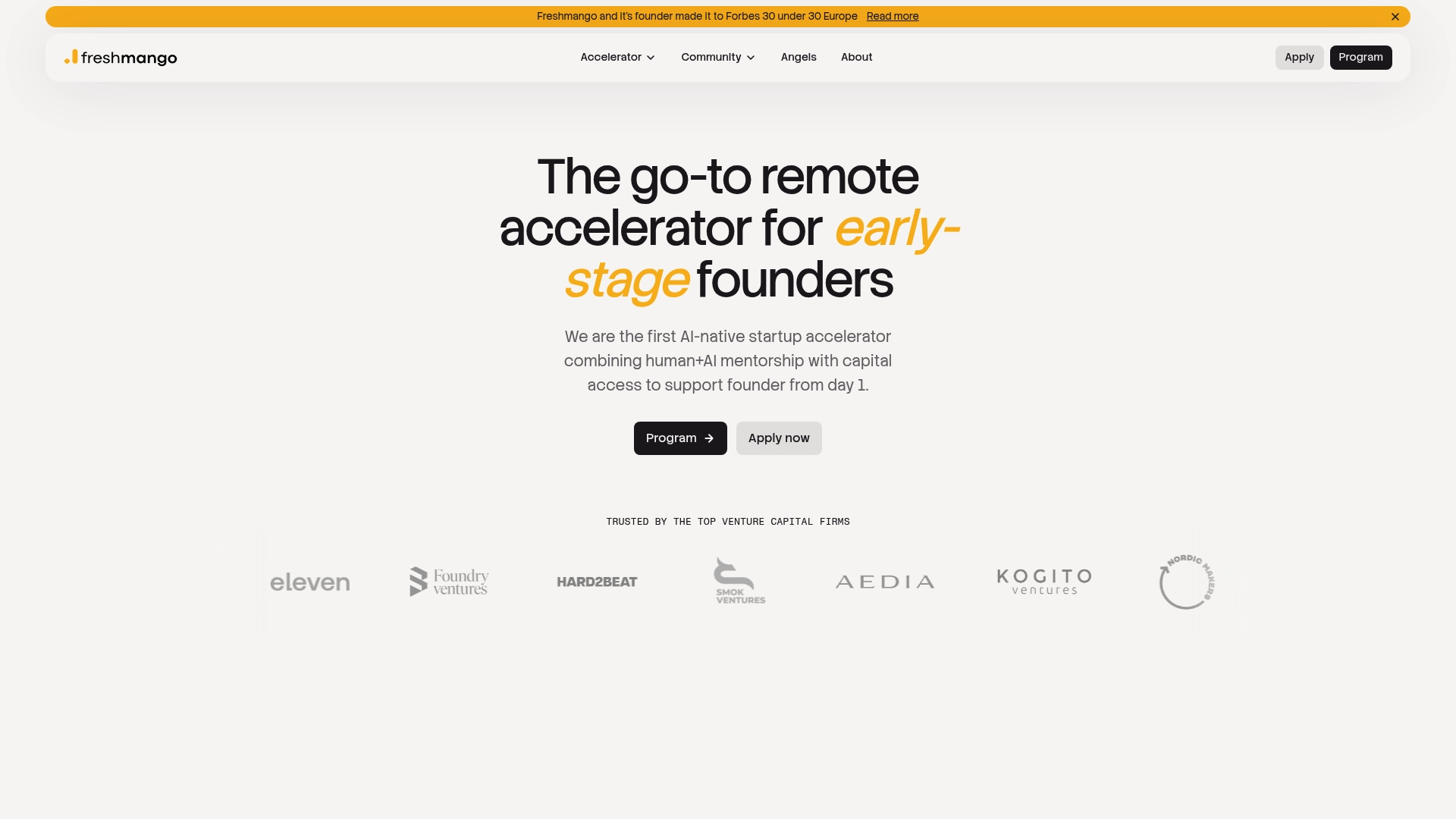
Freshmango is built for founders who want to move fast without giving away their company prematurely. Through the Freshmango equity-free accelerator, you get mentorship from industry leaders, investor networking, pitch coaching, and AI-powered tools, all without handing over equity for access. Whether you are just starting out or preparing for your first raise, the remote program meets you where you are. See how other founders have done it through real founder success stories that show what investor readiness actually looks like in practice.
Frequently asked questions
What is the main difference between venture funding and angel investing?
Venture funding typically involves funds managed by professionals with pooled institutional capital, while angel investing comes from individuals using their own money. VC funds are managed by general partners who answer to limited partners for returns.
How much equity do VCs typically take in early rounds?
VCs often take 15-25% equity in Seed or Series A rounds, though exact terms vary by stage and company. Understanding pre and post-money valuation scenarios is essential before entering negotiations.
What are common reasons startups get rejected by VCs?
The most frequent reasons are lack of product-market fit, a small addressable market, or a mismatch between founder skills and the problem. VCs prioritize outlier returns, so startups must demonstrate both large market potential and early traction.
How long does the venture fundraising process usually take?
Most VC rounds take 3 to 6 months from initial outreach to close, depending on your founder network and current market conditions. Having warm intros and a clean data room significantly compresses that timeline.
Is it possible to raise VC and stay in control of my company?
Yes, with the right negotiation approach. By structuring favorable board terms and managing dilution carefully, founders can retain meaningful control. Board seats and vesting schedules are the most important governance levers to negotiate upfront.
Recommended