Unlock Founder Networking Strategies for Faster Startup Growth

Most first-time founders spend months collecting business cards, attending every pitch night, and sliding into cold DMs, only to realize none of it moved the needle. The hard truth is that ineffective networking is one of the most common ways early-stage founders lose precious runway. Networking behaviors strongly influence startup success, but the keyword is behaviors, not volume. The difference between founders who close their first round in six months and those who spend two years chasing dead ends often comes down to who they connect with, how they prepare, and whether they can measure what’s actually working.
Table of Contents
Key Takeaways
PointDetailsQuality over quantityA few high-value relationships are more valuable than a huge contact list.Warm intros winAccess to the right mentors and investors comes fastest through strong mutual connections.Measurement mattersTrack your networking impact regularly to double down on what really drives growth.Lean on curated programsJoining specialized groups or accelerators gives vetted access to key people and resources.
Defining effective networking for founders
Effective networking for early-stage founders is not about how many people you know. It’s about whether the right people know you, trust you, and are willing to act on your behalf. That distinction matters enormously when you’re pre-seed and every conversation needs to carry weight.
Sociologists break professional relationships into three types of social capital. Structural capital refers to the size and shape of your network. Relational capital is the trust and goodwill you’ve built with specific people. Cognitive capital is the shared understanding and language you develop with others in your field. For founders, relational and cognitive capital almost always outperform structural capital at the early stage.
Network size is not always predictive of early growth. Context and quality of connections matter far more. A founder with 12 deeply trusted relationships in their niche will typically outperform one with 1,200 LinkedIn connections who barely know their name.
The four relationship types that genuinely move the needle for early-stage founders are:
Each of these relationships serves a distinct function. Mentors accelerate your learning curve. Investors open doors to capital and warm intros. Peer founders keep you grounded and informed. Early customers give you the traction that makes every other conversation easier.
“The goal of networking is not to collect contacts. It’s to build a small circle of people who are genuinely invested in your success.”
Broad events and generic startup meetups rarely produce the depth of connection you need. Niche communities, curated accelerator cohorts, and sector-specific forums are where real alignment happens. You can explore how this plays out in practice through startup case studies from founders who built meaningful networks from scratch. For a deeper look at how equity decisions intersect with network strategy, the equity-free founder insights piece is worth your time.
Relationship typePrimary valueBest context to find themMentorGuidance, introductionsAccelerators, alumni networksInvestorCapital, portfolio supportSyndicates, demo days, warm introsPeer founderAccountability, shared intelCohorts, niche Slack groupsEarly customerValidation, referralsCommunities, direct outreach
Building your core network: Preparation and essentials
Knowing who you need is only half the equation. Showing up unprepared to those conversations is one of the most common ways founders squander good opportunities. Before you reach out to anyone, you need to have three things ready: a concise pitch, a specific ask, and a one-paragraph intro blurb you can paste into an email or a mutual connection’s message.
Your pitch should answer three questions in under 60 seconds. What problem are you solving? Who has that problem? Why are you the right person to solve it? Your ask should be equally specific. Vague requests like “I’d love to pick your brain” are easy to ignore. Specific asks like “I’d love 20 minutes to get your read on our go-to-market approach” are far more likely to get a yes.

Warm introductions are significantly more effective than cold outreach. When a trusted mutual contact vouches for you, the person receiving the intro is already primed to take you seriously. Cold emails, by contrast, require you to earn trust from zero in the first three sentences. That’s not impossible, but it’s a much steeper climb.
Family and friend networks with private capital exceeding $15,000 actually predict accelerated early growth more reliably than large professional networks for some startups. This is a reminder that your existing relationships, even informal ones, carry real strategic value. Don’t overlook them while chasing prestigious strangers.
Outreach typeResponse rateTrust baselineBest use caseCold emailLowZeroLast resort, high personalization neededWarm introHighPre-establishedInvestor and mentor outreachCommunity engagementMediumEarned over timePeer founders, early customers
Here’s a practical sequence to build your core network:
Pro Tip: Create a simple follow-up template for each relationship type. A mentor follow-up looks different from an investor follow-up. Having these ready means you respond fast and stay top of mind without scrambling. You can also check out startup perks that accelerator programs provide to help founders access tools and intros more efficiently.
Executing high-impact networking behaviors
Preparation sets the stage, but execution is where most founders either win or waste the opportunity. The mechanics of a high-yield networking interaction are simpler than most people think, but they require discipline.
Start by researching the person before every meeting. Know their portfolio, their public writing, and their stated investment thesis or areas of focus. This signals respect and makes the conversation more substantive. Generic conversations are forgettable. Specific, informed conversations get you remembered.
Y Combinator advises founders to hang around smart people, find mentors early, and rely on warm introductions for most VC outreach. This is not casual advice. Most venture capitalists receive hundreds of cold pitches per month. Warm intros from trusted sources cut through that noise immediately.
Here’s a step-by-step process for executing each networking interaction:
The most common mistake founders make is over-pitching. Every interaction becomes a sales moment, and people feel it. Relationships built on mutual value last. Relationships built on one-sided extraction don’t.
“The best networkers in the startup world are the ones who give before they ask, and who ask precisely.”
Pro Tip: Always enter a networking interaction with something to offer. It could be a data point, a connection, or even a thoughtful question that helps the other person think through a challenge. Generosity is memorable.
For founders looking to connect with active investors, the venture syndicate model offers structured access to angels who are already primed to evaluate early-stage deals. You can also see how this plays out in practice through the Techline networking case study.
Measuring and strengthening your network’s impact
Networking without measurement is just socializing. If you’re spending time building relationships, you need to know whether those relationships are producing outcomes that matter for your startup.
Networking behaviors and strong professional activities increase startup success rates in measurable ways. That means you can track this, and you should.
The metrics that matter most for early-stage founders are:
Run a simple network audit every quarter. Look at who you’ve spoken with in the past 90 days and ask whether those conversations produced any of the outcomes above. If a relationship has been warm but unproductive for two consecutive quarters, it may be time to redirect your energy.
MetricTarget (quarterly)Red flagWarm intros requested5 to 10Fewer than 2Mentor meetings3 to 6ZeroCapital conversations2 to 5None progressingNetwork-sourced hires1 to 2All from job boards
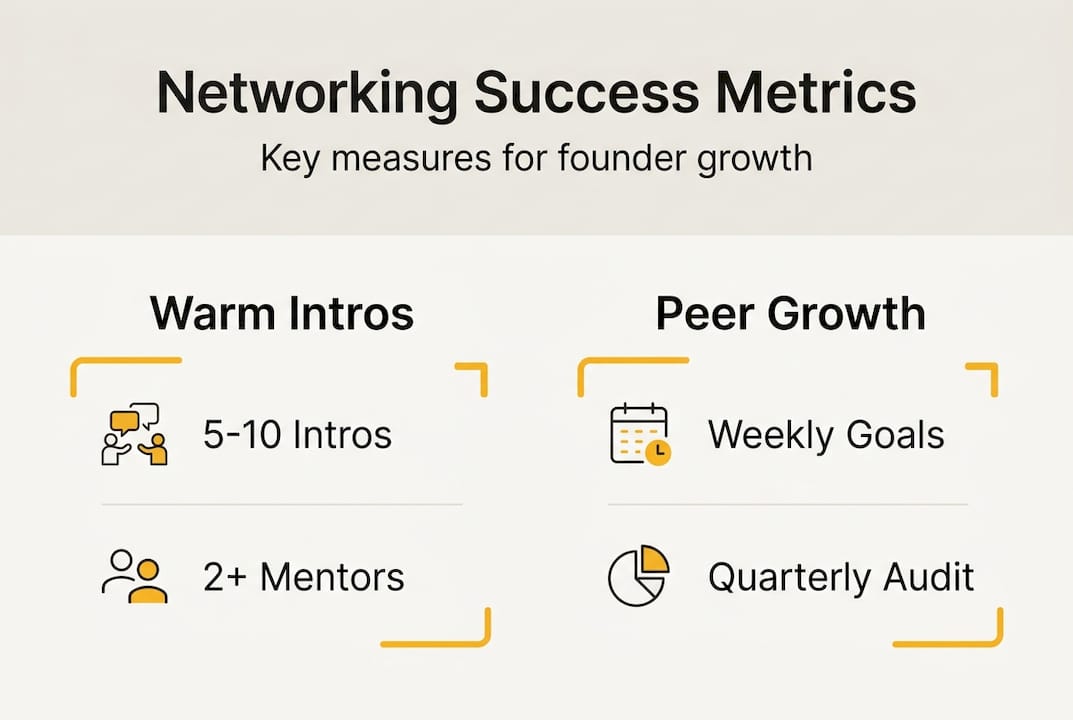
Strengthening weak ties is often more valuable than constantly adding new contacts. A weak tie is someone you know but rarely engage with. These people often have access to entirely different networks than your close circle, which means they can surface opportunities you’d never find on your own. A brief, genuine check-in every few months can reactivate these relationships without feeling transactional.
Peer accountability is another underused tool. Pairing with one or two fellow founders to share weekly networking goals creates social pressure that keeps you consistent. You can draw inspiration from impactful founder stories where consistent relationship-building led to breakthrough moments.
The overlooked truth about early-stage networking
Here’s something most networking advice won’t tell you: for pre-seed founders, a massive network can actually slow you down. When you’re trying to move fast, maintaining dozens of shallow relationships consumes time and energy that should go into building your product and talking to customers.
For emerging high-growth startups, high network size isn’t always predictive of rapid value creation. What matters is a small number of crucial contacts who are genuinely invested in your trajectory.
We’ve seen founders break through because of a single mentor who made one introduction at the right moment. Not because they attended 40 events. The math is simple: three deeply cultivated relationships with the right people will outperform a contact list of 300 acquaintances almost every time.
Younger and first-time founders benefit most from curated programs that do the vetting for them. An equity-free accelerator model puts you inside a pre-qualified network where trust is already built into the structure. That’s a structural advantage that’s very hard to replicate on your own.
The counterintuitive move is to network less but better. Identify your three highest-leverage relationships right now and invest in them deeply before adding anyone new.
Where to expand your founder network next
If this article has clarified one thing, it’s that the quality of your network determines the speed of your growth. You don’t need more contacts. You need the right ones, supported by the right structure.
Freshmango is built for exactly this stage. Our equity-free accelerator connects pre-seed founders with vetted mentors, active investors, and a peer cohort that holds you accountable over 16 weeks. The 16-week remote accelerator is designed to take you from idea to investor-ready without giving up equity. And if you’re looking to get in front of angels who are actively deploying capital, the angel syndicate info page is your next stop. Your network is your trajectory. Let’s build it right.
Frequently asked questions
What is the single most effective networking move for early-stage founders?
Securing warm introductions to trusted mentors or active early-stage investors is the fastest way to access new capital, insights, and opportunities. Warm intros are required for most VC outreach to be taken seriously.
Do solo founders need a large network to succeed?
No, a few targeted high-value connections often matter more than overall network size for pre-seed traction. Network size is not always predictive of early growth at the pre-seed stage.
How can founders quickly connect with useful communities?
Join specialized programs such as accelerators or curated groups that offer vetted introductions and peer accountability. Younger founders benefit from communities like structured cohorts where trust is built into the environment.
Are family and friend networks valuable for fundraising?
Yes, initial capital from family or friends can often speed up early growth more than large professional networks. Private capital from family and friends exceeding $15,000 is linked to accelerated startup growth.
How do I measure if my networking efforts are working?
Track meetings, introductions, and tangible outcomes like capital raised or new hires from your network every quarter. Networking behaviors lead to measurably higher startup success rates when tracked consistently.
Recommended