Why early stage funding matters: accelerate your startup

Most founders assume funding only becomes critical once they have traction. That assumption is one of the costliest mistakes you can make. The timing of your first capital raise shapes your product development speed, your hiring capacity, and your ability to capture market windows before competitors do. Early funding is not just a financial event; it is a strategic accelerator that compounds over time. This guide breaks down what the research actually says, what mentorship adds to the equation, and how to avoid the timing traps that quietly derail promising startups before they ever reach Series A.
Table of Contents
- The real impact of early stage funding
- Beyond money: The mentorship multiplier
- Timing is everything: How funding delays hurt performance
- Who benefits most: Tech, science, and edge-case lessons
- Why most founders underestimate early funding—and what actually matters
- Ready to secure funding and mentorship? Let Freshmango help
- Frequently asked questions
Key Takeaways
| Point | Details |
|---|---|
| Speed drives success | Early funding lets you build, hire, and go to market before competitors catch up. |
| Mentorship multiplies capital | Accelerators and mentors provide expertise and networking as valuable as cash. |
| Timing is critical | Raising late or from misaligned investors risks delays and lost opportunities. |
| Know your edge case | Tech and science founders face different pitfalls—informed choices matter most. |
The real impact of early stage funding
Funding is often framed as a milestone. In reality, it is a mechanism. When capital arrives early, it removes the bottlenecks that slow every bootstrapped team: hiring freezes, delayed product iterations, and the inability to run meaningful marketing experiments. These delays are not just inconvenient; they are compounding. Every month you spend without the right team or infrastructure is a month your better-funded competitors use to pull ahead.
The difference between bootstrapped and funded growth trajectories is stark. A bootstrapped startup typically grows linearly, reinvesting revenue slowly while wearing every hat. A funded startup can hire specialists, run parallel workstreams, and iterate faster. As research confirms, early capital accelerates development, enabling faster hiring, marketing, and scaling operations, turning linear growth exponential.
“It accelerates development speed, enabling faster hiring of top talent, marketing, and scaling operations, turning linear growth exponential.”
Consider what this means practically. If your MVP takes 12 months to build with two founders splitting their time, early funding could compress that to five months with a focused team. That seven-month gap is not just time. It is market feedback, user data, and investor credibility you are not accumulating.
To illustrate the difference, here is how development timelines typically shift with and without early funding:
| Milestone | Bootstrapped timeline | Funded timeline |
|---|---|---|
| MVP completion | 10 to 14 months | 4 to 6 months |
| First paying customers | 18 to 24 months | 8 to 12 months |
| Seed round readiness | 24 to 36 months | 12 to 18 months |
| Team size at 12 months | 2 to 3 people | 6 to 10 people |
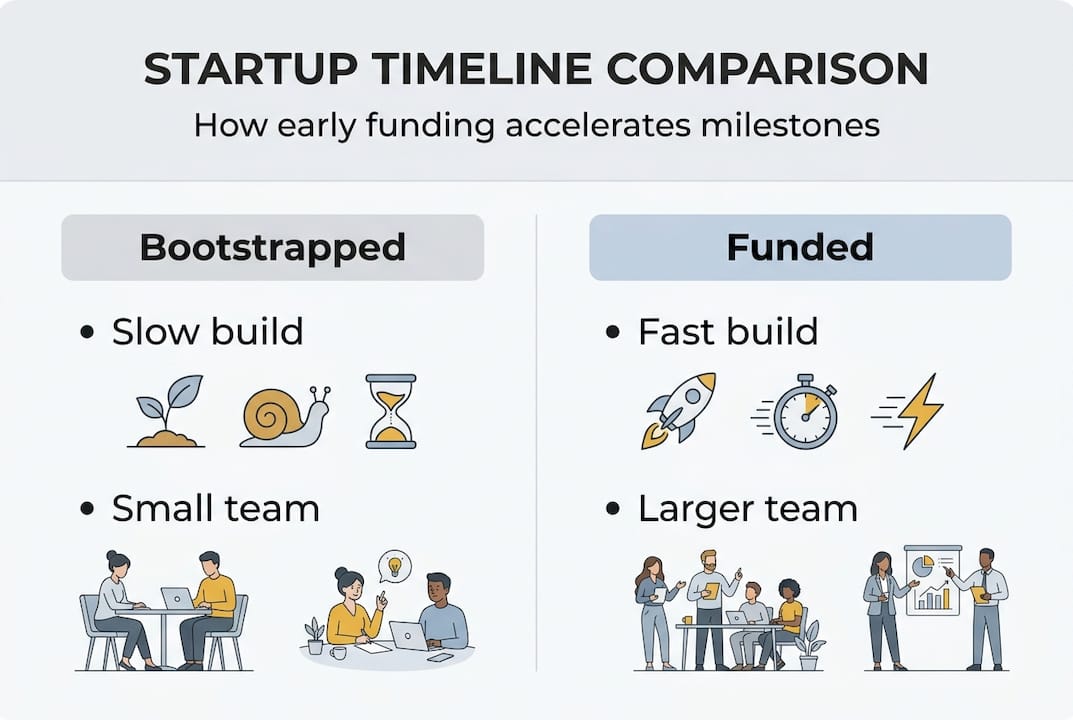
You can also explore startup credits and perks that reduce your burn rate while you build, which is especially useful in those critical early months. For a concrete example of what accelerated timelines look like in practice, the Techline case study shows how structured support changed their trajectory. If you are weighing whether to give up equity at all, understanding equity-free capital benefits is worth your time before you sign anything.
Pro Tip: Allocate a meaningful portion of your first funding round to hiring one or two specialists who solve your biggest execution bottleneck, whether that is engineering, growth, or operations. The team you build early determines how fast you move.
Beyond money: The mentorship multiplier
With capital fueling your engine, mentorship is the navigation system many founders undervalue. Money without direction is just runway. Mentorship turns that runway into a launchpad.
The data on this is clear and somewhat surprising. Pure-tech founders raise 54% more when paired with accelerators, and the mechanism is not just introductions. Mentorship from angels, accelerators, and VCs complements founder skills, improves execution, and increases subsequent funding success. Accelerators also boost regional seed funding activity, creating a rising tide effect for the ecosystems they operate in.
What does strong mentorship actually do for you? Here is what top-tier mentors consistently help founders accomplish:
- Refine your pitch until it speaks directly to investor psychology, not just product features
- Access warm introductions to investors who are already aligned with your sector
- Avoid costly structural mistakes in early contracts, equity splits, and hiring decisions
- Pressure-test your business model before you commit resources to the wrong assumptions
- Accelerate product-market fit by connecting you with potential customers and partners
The comparison between founders who go through structured mentorship programs versus those who raise capital independently tells a consistent story:
| Outcome metric | Without accelerator mentorship | With accelerator mentorship |
|---|---|---|
| Follow-on funding rate | 20 to 30% | 45 to 60% |
| Time to product-market fit | 18 to 30 months | 10 to 18 months |
| Pitch success rate | Low, unstructured | Significantly higher |
| Network access | Limited to personal contacts | Expanded investor and partner network |
If you are evaluating structured support, a remote accelerator program can provide mentorship without geographic constraints. You can also learn how accelerator partnerships expand the reach of these networks for founders globally.
Pro Tip: When evaluating investors or programs, ask specifically what operational or strategic expertise they bring. A smaller check from a deeply connected mentor often creates more value than a larger check from a passive investor.
Timing is everything: How funding delays hurt performance
If mentorship is vital, timing is just as crucial. Here is why the clock is ticking for early founders.

Delaying your funding round is rarely neutral. It costs you in product development cycles, team momentum, and market positioning. The opportunity cost is real and measurable. In competitive verticals, a six-month delay in funding can mean a competitor has already captured the early adopters you needed for your own validation story.
For science-based startups, the risk is even more pronounced. Research shows that funding delays harm performance in science-based startups due to scientist-investor misalignment, with a measurable negative correlation between delay length and company outcomes. When founders and investors are not speaking the same language about timelines, milestones, and risk, the funding process stalls, and the startup pays the price.
Here is how to reduce the risk of funding delays affecting your own trajectory:
- Clarify your value proposition before you start outreach. Investors decide in minutes; your clarity determines whether they stay engaged.
- Start networking with potential investors at least six months before you plan to raise. Warm relationships close faster than cold outreach.
- Understand which investors are the right fit for your stage, vertical, and risk profile. Misaligned pitches waste months.
- Prepare your data room early, including financials, cap table, and traction metrics. Delays in due diligence kill momentum.
- Set a realistic but firm fundraising timeline and communicate it to investors. Urgency without pressure is a legitimate signal.
The Agerapp case study illustrates what happens when a founder gets the timing right. For a broader view of how funding structures affect your options, understanding angel syndicate challenges can help you navigate the landscape more strategically.
Who benefits most: Tech, science, and edge-case lessons
Not all founders will see the same outcomes. Let’s look at who benefits most, and least, from early-stage support.
The research is nuanced here. Pure-tech founders, those building software, platforms, or digital products, experience the greatest fundraising lift from accelerator mentorship. Their products are easier to prototype, validate, and pitch, which means mentorship translates directly into investor-ready narratives and faster closes.
Science-based founders face a different reality. Academic priorities, longer development timelines, and a tendency to communicate in research language rather than commercial terms create friction with investors who are focused on market traction and near-term returns.
“Edge cases: Pure-tech founders benefit most from accelerator mentorship; science startups risk delays from academic priorities.”
Several factors determine whether early funding creates exponential value or modest incremental gains for your specific situation:
- Mentor fit: A mentor with deep experience in your vertical accelerates your learning curve dramatically compared to a generalist.
- Industry vertical: High-velocity markets like SaaS reward speed. Regulated or research-heavy sectors require patience and specialized investor relationships.
- Founder background: First-time founders gain more from structured programs because they have fewer established networks and less pattern recognition.
- Product complexity: Simple digital products benefit from fast iteration cycles that funded teams enable. Hardware or biotech requires longer timelines regardless of capital.
- Market timing: Even well-funded startups can struggle if they enter a market too early or too late relative to customer readiness.
The takeaway is not that science-based founders should avoid early funding. It is that they need mentors who understand both the academic and commercial dimensions of their work. Choosing the right equity-free accelerator means finding a program that matches your specific context, not just your funding stage.
Why most founders underestimate early funding—and what actually matters
Here is the uncomfortable truth: most founders conflate “getting funded” with “getting cash,” and that framing leads them to optimize for check size over everything else. We have seen it repeatedly. A founder raises from an investor who offers the highest valuation but brings no relevant expertise, no warm introductions, and no accountability. The money lands, and six months later, the team is stuck on the same problems they had before.
The research supports a different priority order. Founder-investor alignment, meaning shared expectations about timelines, risk tolerance, and growth strategy, matters as much as the capital itself. Raising too late costs you market windows. Raising from the wrong source can stall your progress even when the bank account looks healthy.
If you could start over, what would you look for first? Most experienced founders say mentorship and network, because those are the inputs that actually shape execution. The real founder outcomes from structured programs consistently show that strategic guidance compounds in ways that cash alone cannot replicate. Prioritize alignment, expertise, and network effects. The right check will follow.
Ready to secure funding and mentorship? Let Freshmango help
If you are ready to put these insights into action for your startup, here is where you can start.
Freshmango is built for exactly this stage. We combine structured mentorship from industry leaders with investor access, pitch coaching, and a suite of AI-powered tools designed to move you from idea to investor-ready within four months. This is not just capital; it is the strategic infrastructure most early founders never get access to.
Explore the equity-free accelerator to see how the program works, check out available startup credits to reduce your early burn rate, and read founder success stories from teams that have been exactly where you are now. Your next step is one decision away.
Frequently asked questions
What is early stage funding?
Early stage funding refers to capital that startups raise immediately after idea validation, usually to build a product, hire first key staff, and accelerate market entry. It is distinct from later-stage rounds in that it funds execution, not just growth.
Why is timing so crucial for startup funding?
Securing capital early enables faster product development and hiring, giving startups a significant competitive advantage over those who delay raising. Every month of delay is a month competitors use to capture your target market.
How do mentorship and accelerators help beyond money?
Accelerators and mentors provide strategic insight and networks that improve execution and increase your chances of raising more funding later. Mentorship complements founder skills, improving both operational decisions and investor relationships.
Are all founders affected the same by early funding?
No. Pure-tech founders benefit most from accelerator mentorship, while science-based startups can face unique delays due to academic-investor misalignment that requires specialized support to navigate.
Recommended