Real-world examples of successful startup accelerators

TL;DR:
- Choosing the right accelerator depends on program fit, mentorship quality, and alumni success rather than prestige.
- Top accelerators like YC, Techstars, and 500 Global have distinct focuses: speed, mentorship, and global scale.
- Founder fit and realistic expectations are critical; accelerators can open doors but won’t solve product-market fit.
Choosing an accelerator is one of the most consequential decisions you’ll make as an early-stage founder. The program you join shapes your cap table, your network, and your trajectory for years. Yet most founders spend more time comparing pitch deck templates than they do evaluating program fit, funding terms, and real alumni outcomes. This article profiles three of the most influential accelerators in the world, Y Combinator, Techstars, and 500 Global, using real data and honest trade-offs. By the end, you’ll have a clear framework for deciding which program, if any, deserves a place in your startup’s story.
Table of Contents
- How to evaluate an accelerator for your startup
- Y Combinator: The gold standard in rapid acceleration
- Techstars: The mentorship-driven marathon
- 500 Global: Diversity and growth at scale
- Comparison: Which accelerator is the best fit?
- Perspective: The uncomfortable truths about accelerators and founder fit
- Launch your success story with expert guidance
- Frequently asked questions
Key Takeaways
| Point | Details |
|---|---|
| Tailor for founder fit | Choose an accelerator that matches your team’s needs, not just for its brand reputation. |
| Compare success metrics | Evaluate metrics like funding, alumni outcomes, and survival rates for meaningful comparison. |
| Beware burnout risks | Accelerators have proven benefits but come with intense pressure and post-Demo Day challenges. |
| Mentorship matters | Programs with rich mentor access can boost execution and founder growth. |
How to evaluate an accelerator for your startup
Not all accelerators are built the same, and the criteria that matter most are rarely the ones in the headline. Before you apply anywhere, you need a framework that cuts through the marketing.
Start with the funding terms. How much equity does the program take, and at what valuation? A $120,000 check sounds generous until you realize it comes with 6% of your company at a pre-revenue stage. That dilution can compound painfully by Series A. Next, examine mentorship quality. Generic office hours from rotating advisors are very different from structured mentor access with domain experts who are accountable to your progress.
Here are the key criteria every founder should evaluate before applying:
- Funding terms and equity: What is the check size, and what percentage does the program take?
- Mentorship model: Is it structured or ad hoc? Are mentors incentivized to help you?
- Industry and stage fit: Does the program specialize in your sector or serve a broad mix?
- Alumni outcomes: What percentage raise follow-on funding? What is the 5-year survival rate?
- Post-program support: Does the accelerator stay involved after Demo Day, or does it move on?
- Cohort size and duration: Smaller cohorts often mean more attention; longer programs allow more iteration.
One of the most common mistakes founders make is chasing brand prestige over program fit. A well-known logo on your pitch deck feels validating, but if the program’s network doesn’t align with your market, you’ll spend three months optimizing for Demo Day instead of building real traction. Research confirms that accelerators have a statistically significant positive effect on startup performance, with program duration and cohort size influencing outcomes, meaning the structure of the program matters as much as its reputation.
Also watch for selection and publication bias. Accelerators market their biggest wins. The Airbnbs and Stripes are real, but they represent a tiny fraction of graduates. Ask to speak with alumni who did not raise a Series A. Their experience will tell you far more than the program brochure.
Pro Tip: Treat Demo Day as a traction checkpoint, not the finish line. The best accelerators build founders who can raise funding six months after Demo Day, not just during it.
Y Combinator: The gold standard in rapid acceleration
With each program’s criteria in hand, let’s see how the world’s best-known accelerator stacks up.
Y Combinator runs a 3-month sprint twice a year, and it is genuinely unlike anything else in the accelerator world. The program currently offers $500K for roughly 7% equity, with a track record that includes a greater than 50% ten-year survival rate, a 45% Series A conversion rate, and alumni companies collectively valued at over $300 billion, including Airbnb and Stripe.
What sets YC apart is its philosophy: it bets on teams, not ideas. Partners famously pivot companies mid-batch if the original idea isn’t working. The alumni network is extraordinarily tight-knit, and the investor access at Demo Day is unmatched. If you get in, you are immediately credible to most top-tier VCs.
Founders who thrive at YC share a few traits:
- Execution speed: YC rewards teams that ship fast and iterate faster.
- Openness to feedback: Weekly partner meetings are direct, sometimes brutally so.
- Resilience under pressure: The environment is high-intensity by design.
- Strong co-founder dynamics: Solo founders can apply, but team chemistry is scrutinized.
“The biggest thing YC does is compress time. You do in three months what might take a year elsewhere. That pressure is either your greatest asset or your biggest liability, depending on your team.”
Y Combinator’s influence on the global startup ecosystem is undeniable, but it is not the right fit for every founder. The post-Demo Day cliff is real. Many teams exit the program with investor interest but no signed checks, and the intensity that drove their progress suddenly disappears. If your startup needs patient iteration or a specialized industry network, YC’s generalist sprint model may not serve you as well as you hope. Review alumni success stories critically and look for companies similar to yours, not just the famous outliers.
Techstars: The mentorship-driven marathon
If you prefer guidance and network over a pure sprint, Techstars is where mentorship is the main focus.

Techstars runs a 3-month program with a very deliberate structure. Month one is called “Mentor Madness,” where founders meet over 100 mentors in rapid succession. Month two shifts to execution against defined KPIs. Month three prepares teams for Demo Day. It is a rhythm that forces both broad input and focused delivery.
The funding and follow-on data is compelling: Techstars offers between $120,000 and $220,000 in funding, and 74% of its portfolio companies raise further funding within three years. Alumni include DigitalOcean, SendGrid, and ClassPass. The program operates across dozens of cities and industries, which means there is likely a Techstars vertical or geography that aligns closely with your market.
Founders who get the most from Techstars tend to share these characteristics:
- Appetite for mentorship: You need to be genuinely coachable, not just politely receptive.
- Clarity on KPIs: Month two is unforgiving if you haven’t defined what success looks like.
- Network-first thinking: Techstars alumni are famously collaborative and pay it forward.
- Patience for process: The structured month-by-month flow rewards founders who trust the system.
The main challenge at Techstars is mentor overload. During Mentor Madness, you will receive conflicting advice from dozens of smart people. Founders who lack strong conviction about their direction can end up scattered. The key is to enter with a clear thesis and use mentors to stress-test it, not to define it.
Pro Tip: Before applying to Techstars, identify two or three mentors already in their network whose expertise directly maps to your biggest current challenge. Reference them specifically in your application. It signals that you’ve done real research and know how to use mentor-driven programs strategically.
When comparing top accelerators, Techstars stands out for founders who need structured accountability alongside capital, particularly those in industries where relationships matter more than raw speed.
500 Global: Diversity and growth at scale
If your team represents diverse backgrounds or plans to scale globally, 500 Global offers unique strengths.
500 Global runs a 4-month program with an intentional focus on distribution, growth marketing, and international market access. Where YC optimizes for speed and Techstars optimizes for mentorship, 500 Global optimizes for scale. The program has backed 2,800+ companies across 80+ countries, offering $150,000 for 6% equity, with a 30% post-seed to Series A conversion rate. Alumni include Canva, Grab, and Talkdesk.
The program’s global reach is its most distinctive feature. Cohorts are intentionally diverse, drawing founders from emerging markets, underrepresented geographies, and non-traditional backgrounds. This creates a peer learning environment that is genuinely different from the Silicon Valley monoculture of some competing programs.
“500 Global gave us access to markets we couldn’t have reached from our home country. The network wasn’t just investors, it was operators and distribution partners across Southeast Asia and Latin America.”
Founders who benefit most from 500 Global include:
- International founders seeking U.S. investor access without relocating permanently.
- Consumer and marketplace startups that need distribution expertise, not just product feedback.
- Founders from emerging markets where local accelerator ecosystems are thin.
- Teams with strong growth instincts who want structured frameworks for scaling.
The honest caveat is that quality varies across 500 Global’s many regional programs. The flagship San Francisco cohort operates differently from some international editions. Research the specific program you’re applying to, not just the brand. 500 Global’s growth approach is most powerful when you align with a cohort that shares your market context. Explore available distribution tactics and perks that can extend your runway while you scale.
Comparison: Which accelerator is the best fit?
With each option explored, it’s time to compare them directly and decide what fits your unique journey.
| Feature | Y Combinator | Techstars | 500 Global |
|---|---|---|---|
| Duration | 3 months | 3 months | 4 months |
| Funding | $500K | $120K–$220K | $150K |
| Equity taken | ~7% | ~6% | 6% |
| Mentor model | Partner-led, generalist | 100+ mentors, structured | Growth and distribution focus |
| 10-year survival | >50% | Not published | Not published |
| Series A rate | ~45% | 74% follow-on (3 yrs) | ~30% post-seed to Series A |
| Best for | Execution-focused teams | Mentorship-seekers | Global and diverse founders |
Here is how to use this table for your decision:
- If speed and investor brand matter most, and your team executes fast under pressure, YC is the benchmark.
- If you need structured guidance and a warm network, Techstars’ mentor model and 74% follow-on rate make it a strong choice.
- If you’re scaling internationally or from an emerging market, 500 Global’s reach and distribution focus are hard to match.
- If none of these fit your stage or equity tolerance, consider whether an alternative model serves you better before committing.
The data is clear that selection bias and founder fit matter enormously. YC, Techstars, and 500 Global each have a distinct edge, but not all accelerators are equal, and the best program for a B2B SaaS team in Estonia looks very different from the best program for a consumer app founder in Lagos. Study portfolio outcomes from companies that resemble yours in stage, sector, and geography before you decide.
Perspective: The uncomfortable truths about accelerators and founder fit
Most comparison lists stop at the numbers. Here is what they skip.
The single biggest risk in accelerator selection is not choosing the wrong program. It is overestimating what any program can do for you. Founders routinely enter accelerators expecting the program to solve product-market fit. It won’t. The best accelerators compress timelines and open doors, but the fundamental work of finding customers who love your product is yours alone.
Demo Day is not a milestone. It is a marketing event. Real risks including burnout, post-program cliff, and varying program quality affect even strong teams. The founders who win long-term are those who treat the accelerator as a forcing function, not a destination.
Before you apply, ask alumni one specific question: “What did the program do for you six months after Demo Day?” The answer will tell you everything about whether the support is real or performative. Explore real founder journeys to see what post-program momentum actually looks like. Founder fit trumps prestige, every time.
Launch your success story with expert guidance
If you’ve worked through this comparison and found yourself questioning whether traditional equity-heavy models are the right trade-off for your stage, you’re asking exactly the right question.
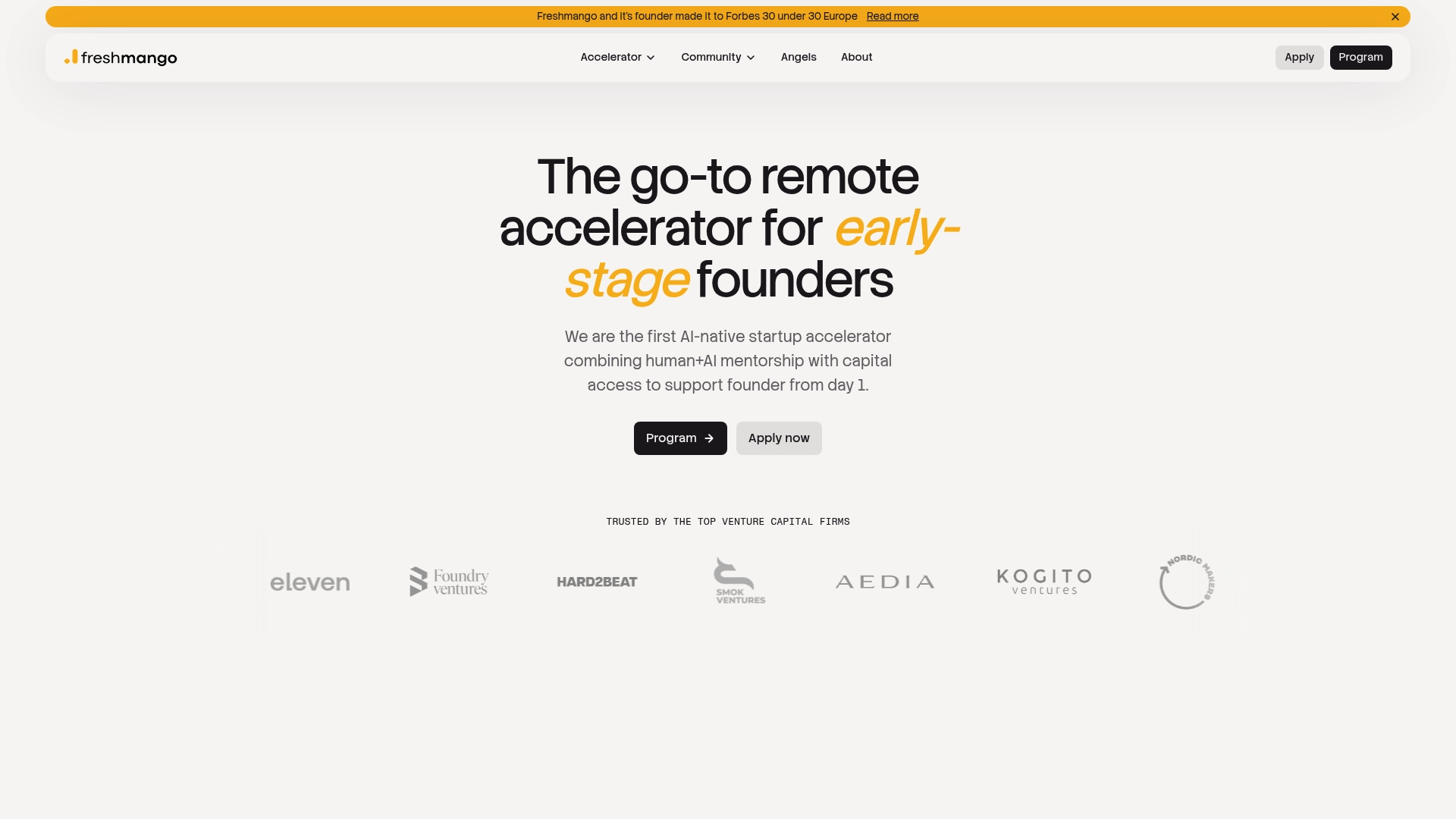
Freshmango is an equity-free accelerator built for early-stage tech founders who want structured support without giving away a chunk of their cap table. The 4-month remote program combines expert mentorship, investor access, pitch coaching, and an AI-powered platform designed to keep you accountable and moving fast. You can also explore startup credits and perks that reduce your operational costs from day one. Read founder success stories to see how teams like yours have moved from idea to investor-ready. If Freshmango fits your goals, the next step is simply finding out.
Frequently asked questions
What is the typical acceptance rate at top accelerators like Y Combinator or Techstars?
Acceptance rates are extremely competitive. Y Combinator receives over 39,800 applications per batch with less than a 2% acceptance rate, and Techstars typically falls below 3%.
How much equity do accelerators usually take in exchange for funding?
Most leading programs take 5 to 7% equity. Y Combinator, Techstars, and 500 Global all provide between $120,000 and $500,000 for roughly that range, though terms vary by program and batch.
What happens after Demo Day in an accelerator?
Many founders face a steep drop-off in momentum once the program ends. Burnout and post-program cliff are documented risks, and sustaining investor conversations without program infrastructure requires deliberate planning well before Demo Day arrives.
Can international founders join top accelerators?
Yes. 500 Global supports startups in over 80 countries, and Techstars hosts programs worldwide, making both accessible to founders outside the United States.
How do I decide which accelerator is best for my startup?
Match program structure, mentor quality, and alumni outcomes to your team’s specific goals. Founder fit matters more than prestige, and program style differences are significant enough to make the wrong choice genuinely costly.
Recommended